The amazing love God showed us by giving His son to die for our sins means that in return, we should accept that love and grace by being faithful and loving Him. That is the key to our salvation.
Isaac Watts, the “Father of English Hymnody,” was born on July 17, 1674 in Southampton Hampshire, England. Since his family was Non-Conformists, which means they were not Anglican, Watts was not eligible to attend Oxford or Cambridge. Instead, he attended the Dissenting Academy in Stroke, Newington London until he was 20 years old. His next two years were spent writing and most likely resulted in his works on logic, geography and astronomy.
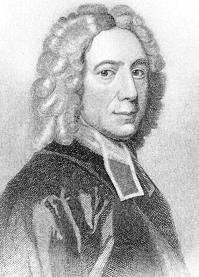
The family of Sir John Hartopp hired Watts as chaplain and tutor in 1696. In 1699 Watts entered the pastorate as the assistant at Mark Lane Independent Chapel in London, a congregational chapel. In 1702 he became the senior pastor.
He held that position for 46 years but was not able to preach very regularly due to his ill health.
In 1712 he was invited to spend a week at the home of Sir Thomas Abney, a wealthy dissenter and he basically stayed there the rest of his life. Watts died in 1748. He would not have survived nearly as long had it not been for the wonderful care he received from Lady Abney and her daughter.
Isaac Watts is credited with writing over 800 hymns. Some of the most well-known include
Joy to the World
When I Survey the Wondrous Cross
O God, Our Help in Ages Past
This is the Day the Lord Hath Made
Alas and Did My Savior Bleed (subject for this meditation)
The current edition of the United Methodist Hymnal contains 12 of his hymns. Here are the words to our hymn of meditation:
Alas! and did my Savior bleed,
and did my Sovereign die!
Would he devote that sacred head
for sinners such as I?
Was it for crimes that I have done,
he groaned upon the tree?
Amazing pity! Grace unknown!
And love beyond degree!
Well might the sun in darkness hide,
and shut its glories in,
when God, the mighty maker, died
for his own creature’s sin.
Thus might I hide my blushing face
while his dear cross appears;
dissolve my heart in thankfulness,
and melt mine eyes to tears.
But drops of tears can ne’er repay
the debt of love I owe.
Here, Lord, I give myself away;
’tis all that I can do.
Isaac Watts poses two very similar questions in these lyrics.
The first question is basically would God (sacred head) die for sinners? Jesus is the sacred head and Jesus is a member of the Godhead (Father, Son, and Holy Spirit).
The second question is a little more specific.
Did He suffer death on the cross for my sins (crimes)?
Watts answers his own questions in verse 3; “when God, the mighty maker, died for His own creature’s sins”. So, Watts is basically presenting the gospel to us in these 5 verses as follows.
- God made us
- We sin against Him
- Jesus’ sacrifice is the only way to pay the debt we owe for our sins
- God sent Him for that purpose because of His love for us
- It was an act of amazing grace
- We are overwhelmed in thankfulness
- Our only response is to come to Him
So, the short answer to the two questions posed by Watts is an unequivocal “Yes”! But, the conclusion of verse 5 suggests another question. Why should I “give myself away” (to Him) as opposed to something/someone else? That’s our question for meditation.
The book of Hebrews has been very important for me to understand two critical truths:
(1) the supremacy of Christ, and
(2) seriousness of warnings.
I commend the study of this book. We don’t have time for that here. But, let’s look at some of the highlights that address these two fundamental truths.
Christ and the new covenant
First, I give myself to Him because He is better than any other alternative. The book of Hebrews is all about the supremacy of Christ. Let’s looks at some examples.
In Hebrews 1:8 – 9, God indicates the supremacy of Christ as follows.
But about the Son he says,
Your throne, O God, will last for ever and ever;
Hebrews 1: 8-9
a scepter of justice will be the scepter of your kingdom.
You have loved righteousness and hated wickedness;
therefore God, your God, has set you above your companions
by anointing you with the oil of joy.
The writer of Hebrews describes Christ’s superiority to Moses in chapter 3 as follows.
Therefore, holy brothers and sisters, who share in the heavenly calling, fix your thoughts on Jesus, whom we acknowledge as our apostle and high priest. He was faithful to the one who appointed him, just as Moses was faithful in all God’s house. Jesus has been found worthy of greater honor than Moses, just as the builder of a house has greater honor than the house itself. For every house is built by someone, but God is the builder of everything. “Moses was faithful as a servant in all God’s house,” bearing witness to what would be spoken by God in the future. But Christ is faithful as the Son over God’s house.
Hebrews 3: 1-6
Christ is greater than the Old Testament priests as described in chapter 4.
Therefore, since we have a great high priest who has ascended into heaven, Jesus the Son of God, let us hold firmly to the faith we profess. For we do not have a high priest who is unable to empathize with our weaknesses, but we have one who has been tempted in every way, just as we are—yet he did not sin.
Hebrews 4: 14-15
In chapter 9 we read that Christ is the ultimate sacrifice for our sins and the mediator of the new covenant with God.
But when Christ came as high priest of the good things that are now already here, he went through the greater and more perfect tabernacle that is not made with human hands, that is to say, is not a part of this creation. He did not enter by means of the blood of goats and calves; but he entered the Most Holy Place once for all by his own blood, thus obtaining eternal redemption. The blood of goats and bulls and the ashes of a heifer sprinkled on those who are ceremonially unclean sanctify them so that they are outwardly clean. How much more, then, will the blood of Christ, who through the eternal Spirit offered himself unblemished to God, cleanse our consciences from acts that lead to death, so that we may serve the living God!
For this reason Christ is the mediator of a new covenant, that those who are called may receive the promised eternal inheritance—now that he has died as a ransom to set them free from the sins committed under the first covenant.
Hebrews 9: 11-15
The old covenant required the sacrifice of animals for the sins of the people. The priests were required to do this annually. But, the new covenant is the once for all time sacrifice of Jesus on the cross for our sins. He is now the mediator of that new covenant and continues to intercede with the Father on our behalf…for our past, present and future sins. Therefore His sacrifice (new covenant) is far superior to the old covenant. The old covenant was ceremonial…the new covenant is a real cleansing, a real change of heart! We also see this in chapter 5, verse 9: “and, once made perfect, he became the source of eternal salvation for all who obey him”.
The consequences of unbelief
The book of Hebrews also provides us with some stern warnings about the consequences of unbelief. In chapter 2, the writer provides us with the first of a number of such warnings as follows.
We must pay the most careful attention, therefore, to what we have heard, so that we do not drift away. For since the message spoken through angels was binding, and every violation and disobedience received its just punishment, how shall we escape if we ignore so great a salvation? This salvation, which was first announced by the Lord, was confirmed to us by those who heard him. God also testified to it by signs, wonders and various miracles, and by gifts of the Holy Spirit distributed according to his will.
Hebrews 2: 1-4
We are reminded here of the authenticity of the gospel. This salvation is true and is testified by those who heard it. All sin will be punished. Therefore, our sins will be punished if we neglect this great gospel of salvation. In chapter 6 we find another such stern warning.
Land that drinks in the rain often falling on it and that produces a crop useful to those for whom it is farmed receives the blessing of God. 8 But land that produces thorns and thistles is worthless and is in danger of being cursed. In the end it will be burned.
Hebrews 6: 7-8
The gospel falls on us like rain falling on the earth. Some of us believe the gospel and produce fruit. Others reject the gospel and do not produce fruit. Notice what happens to those in the end! Chapter 10 makes this very clear.
If we deliberately keep on sinning after we have received the knowledge of the truth, no sacrifice for sins is left, but only a fearful expectation of judgment and of raging fire that will consume the enemies of God. Anyone who rejected the law of Moses died without mercy on the testimony of two or three witnesses. How much more severely do you think someone deserves to be punished who has trampled the Son of God underfoot, who has treated as an unholy thing the blood of the covenant that sanctified them, and who has insulted the Spirit of grace? For we know him who said, “It is mine to avenge; I will repay,” and again, “The Lord will judge his people.” 31 It is a dreadful thing to fall into the hands of the living God.
Hebrews 10: 26-31
The consequences of ignoring the Savior’s blood shed on the cross for us are frightful! Finally, the author underscores the importance of faith throughout chapter 11. Verse 6 makes this very clear.
And without faith it is impossible to please God, because anyone who comes to him must believe that he exists and that he rewards those who earnestly seek him.
Hebrews 11: 6
Faith (belief) in Him as our savior who did bleed and die for our sins is the key to our salvation.
My prayer is that we will not ignore such a great salvation! Amen.
 Hymns for Him