The author of this hymn, Thomas Obediah Chisholm, worked at various times as a newspaper editor, insurance salesman and minister. But he’s best remembered for his many hymns. Despite ill health, he never doubted God’s presence and love. This hymn meditation focuses on God’s love and mercy . . . and what that tells us about forgiving others.
Thomas Obediah Chisholm was born in a log cabin near Franklin, Kentucky on July 29, 1866. He became a teacher at age 16 despite the lack of rigor of his own education. At age 27 he came to faith in Christ during a revival led by the evangelist Dr. Henry Clay Morrison. Chisholm was also editor of the local newspaper in Franklin for five years.
In 1903, he was ordained into the Methodist Episcopal Church, South. Yet he was only able to serve as a minister for one year due to health problems. When he was able to work, he was involved in journalism, insurance and evangelistic activities. Due to his bouts with ill health, the third chapter of Lamentations became very comforting to Chisholm. Specifically, chapter 3, verses 22 – 23 which are as follows.
Because of the Lord’s great love we are not consumed, for his compassions never fail. They are new every morning; great is your faithfulness.
Lamentations 3: 22-23
He sent a number of his first hymns to Fannie Crosby, a notable composer who encouraged him. Chisolm’s first success was “O, To Be Like Thee.” Another popular hymn was “Living for Jesus.” However, his greatest success by far was “Great Is Thy Faithfulness” which he wrote and had published in 1923.
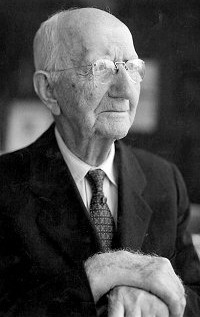
The hymn’s success came slowly as it first came to the attention of Dr. Will Houghton, a famous evangelist and a president of the Moody Bible Institute. The hymn’s worldwide popularity came when George Beverly Shea sang it at many of the Billy Graham crusades .Chisholm wrote over 1200 hymns before his death at the age of 93.
The lyrics give a powerful message of faithfulness, mercy and God’s everlasting love.
Great is thy faithfulness, O God my Father.
There is no shadow of turning with thee.
Thou changest not, thy compassions, they fail not.
As thou hast been thou forever wilt be.
Refrain:
Great is thy faithfulness!
Great is thy faithfulness!
Morning by morning new mercies I see.
All I have needed thy hand hath provided.
Great is thy faithfulness, Lord, unto me!
Summer and winter, and springtime and harvest,
sun, moon, and stars in their courses above,
join with all nature in manifold witness
to thy great faithfulness, mercy, and love. [Refrain]
Pardon for sin and a peace that endureth,
thine own dear presence to cheer and to guide,
strength for today and bright hope for tomorrow;
blessings all mine, with ten thousand beside! [Refrain]
Love, Mercy and Forgiveness
“Great is Thy Faithfulness” largely contains praises to God for His great faithfulness, mercy and, love. The third verse begins with the phrase “pardon for sin and a peace that endureth” as one of the examples of God’s mercies towards us.
That’s the subject for this meditation: the pardon . . . forgiveness of God . . . which comes because of His great love for us. The question is what is our response? That’s a very big question which is worthy of a lengthy discussion. However, let’s focus on what Jesus had to say about our response to God’s forgiveness.
Our meditation begins with The Lord’s Prayer, which is certainly the most recognized and most repeated prayer in all of Christianity. There are a number of petitions in the prayer and one real command or exhortation . . . for us to forgive our debtors as God has forgiven us of our debts (sins). So, our response to this great mercy God has shown us is to forgive others.
John MacArthur wrote and preached a series of sermons on forgiveness in 1991 . . . thirty years ago (six sermons on Philemon). Consider a portion of one of those sermons.
We live, obviously, in a society that knows little about forgiveness. We live in a society that cares little about forgiveness. In fact, I would think that one of the major contributors – if not the major contributor – to the destruction of relationships in our culture is the absence of forgiveness. Our culture pushes us to be unforgiving. It celebrates and exalts people who are not willing to forgive. We make heroes out of the Dirty Harrys and the Rambos who murder people out of vengeance.
As a result of the sinfulness, the wickedness, and the lack of any kind of Christian social restraint in our culture, we have a society filled with bitterness, filled with vengeance, filled with anger, filled with hate, filled with hostility toward others.
This can be seen in the retaliatory kind of crimes that become so commonplace in our day. It can be seen in the suits, lawsuits against everyone for everything conceivable and inconceivable. In fact, it is frightening to think about the fact there are more people in law school today than in all other professional graduate schools combined. We are going to proliferate an almost endless number of attorneys to take care of an endless number of lawsuits as people retaliate back and forth for every minuscule and major issue of life that has been foisted upon them.
Even counselors today are telling us it’s not healthy to forgive. That’s a new one.
A new popular book written by Susan Forward is titled Toxic Parents. The thesis of the book is really the prevailing attitude of our present-day culture . . . a negative attitude toward forgiveness. There’s one chapter in the book entitled “You Don’t Have To Forgive.” In other words, you are a victim of some toxic parents who poisoned you and until you put the blame on them where it belongs, you’re not going to be a healthy person.
We live in a retaliating, vengeful, hostile, angry culture that wants to make everybody else the perpetrator of a crime against us and us, frankly, responsible for nothing except vengeance. Certainly ours is the most hostile, the most angry, the most unforgiving, the most vengeful culture that I have ever experienced in my brief lifetime.
Source: It is about Him…:The Characteristics of One Who Forgives by John MacArthur
How appropriate are his words (written 30 years ago) for today? What do we see all around us? How much forgiveness do we see . . . especially among our national leaders? With that question in mind, let’s continue to look at what Jesus taught about forgiveness.
Following His teaching on The Lord’s Prayer, Jesus said this:
For if you forgive other people when they sin against you, your heavenly Father will also forgive you. But if you do not forgive others their sins, your Father will not forgive your sins.
Matthew 6: 14-15
This is a stern warning to us about the lack of forgiveness. Later on in Matthew, Peter asked Jesus about forgiveness. We find the response of Jesus along with a parable on this topic recorded in Matthew 18. Peter wanted to know specifically how many times he should forgive someone . . . up to 7 times! Jesus’ response was not what he wanted to hear. Jesus said up to 70 times 7 . . . in others words you are to keep on forgiving that person. Then, He told them a parable about forgiveness, the unforgiving servant (verses 23 – 35).
The thankless servant
In this parable, the king (God) wanted to settle accounts with His servants (the judgment day). So, He called in a servant who owed Him a great deal of money (10,000 talents). In today’s dollars, this would amount to hundreds of millions of dollars. The servant owed a debt he could not pay. At the judgment day, we all owe a debt we cannot pay. Either it has been paid for by the sacrificial blood of Jesus or we still owe it! The servant fell on his knees before his master and begged for mercy. The servant’s master took pity on him, canceled his debt and let him go.
Those who repent and believe in Jesus will have the debt they cannot pay canceled by God because Jesus paid their debt . . . atoned for their sins. This is a wonderful story about the forgiveness of God with a happy ending . . . right?
But, the story does not end there. This servant went out and found another servant who owed him 100 denarii . . . about 100 day’s wages. The first servant demanded that the second servant pay him back. The second servant begged for mercy and indicated that if the first servant would be patient, he would repay all that he owed. But, the first servant refused and had the second servant thrown into prison.
When the king (master) heard about this, he was furious! He called the first servant in and expressed severe anger toward this servant. He had him “turned over to the jailers to be tortured until he should pay back all he owed.” Remember he owed an amount that he could not possibly repay. Now these are the words of Jesus in the beginning and end of this parable.
Beginning: “Therefore the kingdom of heaven is like a king who wanted to settle accounts with His servants.”
Ending: “This is how my heavenly Father will treat each of you unless you forgive your brother from the heart.”
There are numerous examples . . . word pictures of the importance of forgiveness in the Bible (some estimate over 75). There is no more fundamental characteristic of a true follower of Jesus than the practice of forgiveness!
Forgiveness is at the heart of Christianity.
How can we be truly forgiving?
At this point, I could very easily be thinking; “this is too hard, I can’t do this.” That’s true if I rely on my own strength. But, if I have repented of my sins and believe in Jesus, I have the Holy Spirit. The Holy Spirit helps me grow in the grace and knowledge of Jesus . . . I become more Christ-like.
I must “put on the new clothes” and take off the old ones as Paul describes in Colossians 3. I do not achieve perfection but my aim and my actions indicate that I am becoming more and more holy (sanctified). I become more and more loving and merciful . . . forgiving. Along the way I will stumble. So, I must confess my continuing sins when they occur and make every effort to avoid sin in the future. It is a daily struggle/process as Paul describes in Romans chapter 7.
Finally, consider these words of Bishop J. C. Ryle, Bishop of Liverpool in the late 1800s.
Do not let doubts and fears rob you of your peace. Believe me, you must be content to go to heaven as a sinner saved by grace. And, you must not be surprised to find daily proof that you are really a sinner so long as you live.
Closing prayer
My prayer is that God would grant me the strength, by His grace, to forgive others and that He would work in the hearts of our nation’s leaders so that they would be merciful and forgiving toward those with whom they disagree.
Amen.
 Hymns for Him