This meditation discusses the range of emotions – from courage to fear, from worship to denial, from love to abandonment — that we would have witnessed had we been there when they crucified our Lord.
This stirring African American spiritual was probably written before the Civil War. It was first published in William Barton’s Old Plantation Hymns in 1899. There were possibly earlier influences on this spiritual from another song which was popular in Tennessee, Have You Heard How They Crucified My Lord? Several additional stanzas have since been written.
Our song of meditation was included in the Episcopal Hymnal in 1940. . . the first spiritual to be included in any major American hymnal. Major artists who have recorded this song include Johnny Cash, Paul Robeson, Marion Williams, Roy Acuff, Harry Belafonte, and Chris Rice.
The initial words to this moving spiritual are as follows.
Were you there when they crucified my Lord?
Were you there when they crucified my Lord?
Oh, sometimes it causes me to tremble, tremble, tremble.
Were you there when they crucified my Lord?
Were you there when they nailed him to the tree?
Were you there when they nailed him to the tree?
Oh, sometimes it causes me to tremble, tremble, tremble.
Were you there when they nailed him to the tree?
Were you there when they laid him in the tomb?
Were you there when they laid him in the tomb?
Oh, sometimes it causes me to tremble, tremble, tremble.
Were you there when they laid him in the tomb?
Were you there when God raised him from the tomb?
Were you there when God raised him from the tomb?
Oh, sometimes it causes me to tremble, tremble, tremble.
Were you there when God raised him from the tomb?
We have included a traditional arrangement of this spiritual as well as another more recent song entitled The Funeral of Jesus by Big Mo. We hope you will enjoy both as a component of this meditation regarding some of the events of Holy Week.
When a phrase is repeated, it emphasizes a thought. In our hymn of meditation we find the phrase Were you there? repeated 3 times in each stanza for a total of 12 occurrences.
Imagining the sight
Let’s examine the meaning of Were you there? more closely. Certainly, we were not there when Jesus was crucified . . . it was over 2000 years ago! But, the real question is what we would have seen if we had been there. For our meditation on this song, I want to suggest eight human reactions we would have seen if we had been there and then close with another question.
The crucifixion of Jesus is recorded in all four gospels. The week begins with His triumphal entry as recorded by Luke in chapter 19. Throngs of His disciples were gathered along the road. They spread their cloaks on the road and as He approached they exclaimed, “Blessed is He who comes in the name of the Lord.” They were celebrating Him as their king.
The first reaction we see from the crowds is worship. Early in Holy Week they were worshipping Him as their king as they reflected on all the mighty works they had seen Him perform.
However, after Jesus cleansed the temple and told the parable of the wicked tenants in Luke 20, the people abandoned Him. He did not meet their expectations. It became apparent to them that He was not going to deliver them from Roman rule and re-establish Israel to most favored nation status. So, we see the second reaction to Him . . . abandonment!
One of the twelve, Judas, was also disappointed that Jesus was not going to be a traditional king. Judas, who was influenced by selfish motives, realized that he would not be a part of a new ruling authority. At the Lord’s Supper (Maundy Thursday) Jesus knew one of the 12 would betray Him and revealed to his disciples that one of them would be a traitor. Luke records in chapter 22 that he warned “woe to that man by whom He is betrayed.” Even with this warning from Jesus, Judas, possessed by the devil (John 13), betrayed Jesus. Judas led the high priests and guards to Jesus and betrayed Him with a kiss (Luke 22). So, the third reaction during this week is betrayal.
Jesus is handed over to the high priests for trial. The trial is done in the middle of the night. Matthew records that they sought testimony against Him but could find none . . . though many false witnesses came forward (Matthew 26). He was taken to Pilate for trial and Pilate found Him innocent. Pilate sent Him to Herod who also did not find Him guilty (Luke 23). So, although Pilate wanted to punish Jesus and release Him, he was intimidated by the Jewish crowd who wanted Jesus crucified. So Pilate gave in to the crowd and allowed an innocent man to be put to death in a most heinous manner. The fourth reaction during this week is corruption. The corruption of an illegal trial and the conviction of an innocent man . . . a lynching!
As Jesus predicted, most of the 12 scattered during this time. But, Peter and John stayed nearby to watch and find out what was going to happen to their leader. Peter kept his distance, attempting to be inconspicuous. But, he was confronted three times by a servant girl and other bystanders who asked if he was one of Jesus’ disciples. When Jesus was trying to explain to His disciples what was going to happen to Him during this week, Peter was adamant that he would not deny Him but would follow Jesus even if it meant he would also be put to death.
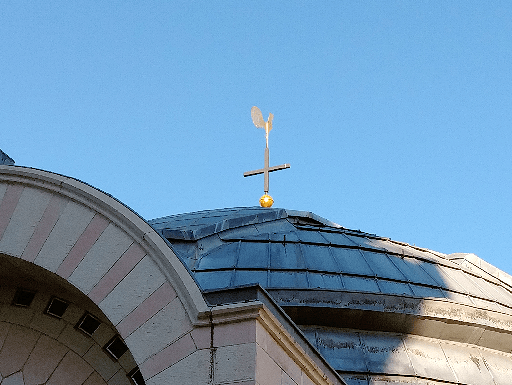
But, after the reality of the impending crucifixion hit Peter, he denied with these words: “I do not know the man.” The fifth reaction during this week is one of denial. Peter denied that he even knew Jesus!
(Photo of the cross with a rooster on top at The Church of St. Peter in Gallicantu. According to tradition, this is the site where Peter denied Jesus three times and then heard the cock crow.)
The other 9 (12 minus Judas, Peter and John) scattered out of fear for their own lives. But some of the women who had ministered to Jesus stayed around. They watched where He was buried and went to prepare spices and ointments to anoint the body. On the first day of the week (Sunday) they came to anoint the body and found that the stone had been rolled away and the tomb was empty (Luke 23 & 24). They thought people had stolen His body. They were afraid, gripped by their fear. But the angels spoke to them and explained that Jesus had risen from the dead as He had told them earlier. So, the sixth reaction we see during this week is fear. The fears of the disciples and the fears of those who found the empty tomb were significant!
From the cross to the tomb
How did the body of Jesus get from the cross of crucifixion to the tomb?
Luke records in chapter 23 that a wealthy man named Joseph (of Arimathea) was a member of the Sanhedrin. Luke identifies this Joseph as a good and righteous man who was looking for the kingdom of God. As a member of the Council, he had not consented to their actions against Jesus. He went to Pilate and asked for the body of Jesus. Once Pilate was convinced (by the Centurion) that Jesus was dead, he gave Joseph the body.
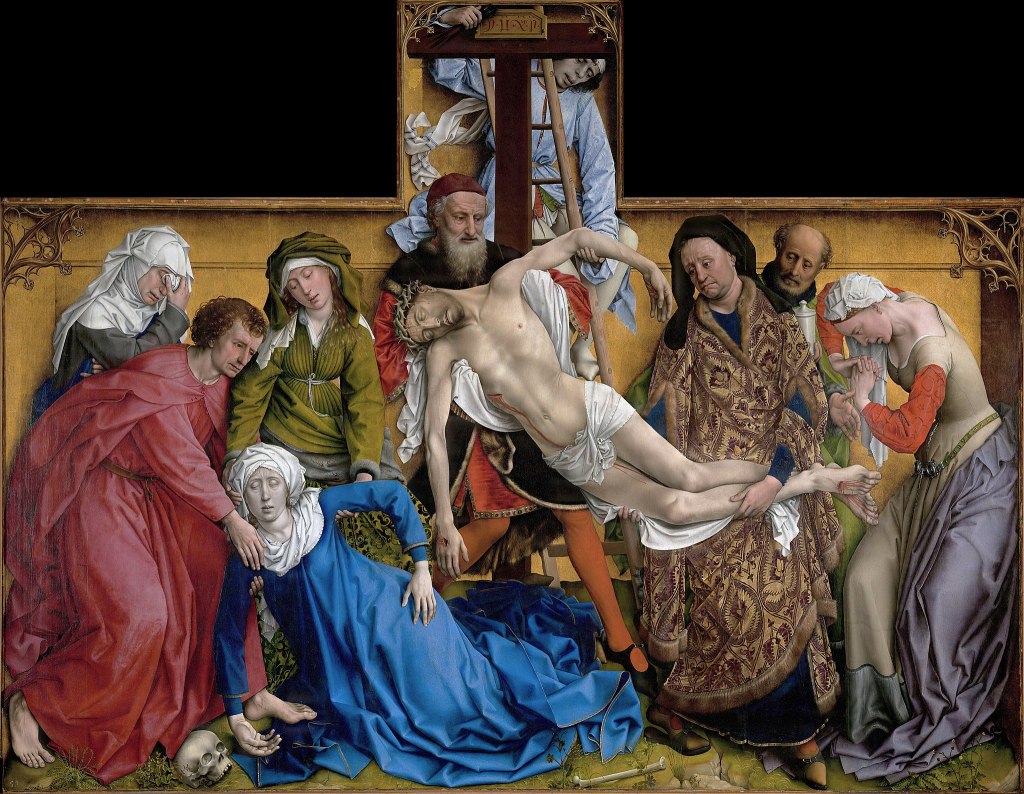
Imagine how difficult and emotional it must have been for Joseph to remove the bloody, tortured body of Jesus from the cross with the spikes driven through His hands and feet! In addition, Nicodemus, who we met in John chapter 3, showed up with approximately 75 pounds of a mixture of myrrh and aloes . . . an amount suitable for a very important person. They used this mixture in wrapping the body in linen cloths. There was no embalming in those days! The actions of the women, Joseph of Arimathea, and Nicodemus were actions of great courage. They displayed great courage in the face of an angry, out-of-control mob that was completely committed to the crucifixion of Jesus . . . even trading Barabbas for Him. So, the seventh reaction we see during this week is courage!
But what motivated this courage? They loved Jesus! Out of love for Him they took great risks. The final reaction we see during this week is one of love. Love for Him . . . because He first loved us!
What about God?
Another question that is often asked is where God was during this week. If God was there, then why did He allow this to happen?
But the answer to that question is simple: God was there! He was there as the Father, the Holy Spirit and obviously . . . the Son. There are at least 8 indicators that God as the Trinity was there. Jesus as the Son of God in all His deity was there!
First, He was there with godly wisdom as He taught the 11 apostles in the Upper Room. John records in chapter 13 that He taught them by example and by foretelling what was going to happen to Him and to them. He promised them the Holy Spirit and gave them the commandment that they must love one another as He loved them. He told them of the place He was preparing for them. He warned them of the trials they would have during their remaining stay on earth. Then, He prayed the longest prayer recorded of Him in John chapter 17. He prayed for them and for us!
Second, Jesus displayed His perfect holiness during this week. When reviled, He did not return that action. He had 12 legions of angels at His disposal to wipe out this earthly opposition . . . but He did not use them (Matthew 26). To be the sacrifice for our sins, once and for all time, Jesus must have been blameless . . . perfectly holy.
Third, Jesus displayed compassion during this ordeal. He was hanging on a cross between two hardened criminals. One of them engaged in mocking Him. But, other one realized that Jesus had done nothing wrong and asked Jesus to remember him when He came into His kingdom. Jesus responded by including this criminal in His kingdom saying, “Today you will be with Me in paradise.” In addition, Jesus displayed compassion for His mother as He provided for her ongoing care when He entrusted her to His beloved disciple, John (19).
Fourth and closely akin to compassion, Jesus displayed love . . . the kind of love He expects of His followers. We are charged to love our enemies (Matthew 5:43 – 48). While hanging on the cross under the most excruciating pain, He cried out, “Father forgive them for they know not what they do” (Luke 23). Earlier in His ministry (as recorded in Mark 10:45), Jesus indicated that He came “to give His life as a ransom for many.” His sacrifice was an act of unselfish love unlike anything ever witnessed by mankind. Paul described this very powerfully in Philippians 2:5 – 8. Jesus was the second person of the Trinity . . . a form of God. Yet, He humbled himself, became a man, and was obedient to the most heinous of all deaths . . . crucifixion!
The Holy Spirit was there giving life to the dead. Joseph of Arimathea and Nicodemus were once spiritually dead; but, they were given life by the Holy Spirit. As a result of this miracle of salvation, they honored, loved and followed Jesus. By the work of the Holy Spirit, even the Centurion had a change of heart and exclaimed, “Truly this was the Son of God.” According to God’s plan for the redemption, Jesus was raised from the dead by the Holy Spirit . . . bringing truth to what had been written (Isaiah 25 and Hosea 13).
“Death is swallowed up in victory.”
“O death, where is your victory?
O death, where is your sting?”
God was there pouring out His wrath on Jesus so that we would not have to bear the wrath of our sins. Isaiah wrote about this in chapter 53: “The Lord has laid on Him the iniquity of us all!” This is the great exchange Paul writes about in 2 Corinthians.
“For our sake he made him to be sin who knew no sin, so that in him we might become the righteousness of God.”
2 Corinthians 5:21
The exchange was our sin for His righteousness!
God was also there in His providence. He orchestrated the actions of Pilate, Herod, Joseph of Arimathea, the guards, the women and all other actions to fulfill His prophecies from the Old Testament. Some examples include the following.
- His legs were not broken but the legs of the two thieves were broken.
- He was taken down and buried by Joseph so that He would be in the ground for 3 days.
- He was buried with the rich although his grave was planned to be with the poor.
- Pilate agreed to His crucifixion even though Pilate found no guilt in Him.
- And, after 3 days He was raised from the dead.
Finally, God was there in His sovereignty. Darkness covered the land for three hours in the middle of the day. The curtain in the temple was torn in two from top to bottom. There was a great earthquake. The rocks were split open. Tombs were opened and many bodies of the saints were raised from the dead and went into the city and appeared to many. God did many miracles during this week . . . attesting to His sovereignty.
From the cross to the present
The real question for us regarding this week is, So what? Do we believe these events happened? If so, what does the crucifixion and resurrection of Jesus mean to each of us?
I pray that you will conclude with me that His crucifixion means that our sin debt is paid . . . once and for all. And, His resurrection means that He will raise us to eternal life with Him. He has conquered death for each of us!
Amen.
 Hymns for Him