Humility is a challenge in a culture that celebrates self-reliance and individual achievement. But as this classic hymn points out, the way to spiritual growth and a closer relationship with God is through embracing humility while seeking God’s will.
Entitlement, anti-authority and lack of submission are three movements which have become very prevalent within our culture today. These phenomena remind me of the poem Invictus which is Latin for “unconquerable.” The famous short poem was written by William Ernest Henley in 1875. The last two lines of this poem have become quite famous and are often quoted.
I am the master of my fate:
Invictus by William Ernest Henley – Poems | Academy of American Poets
I am the captain of my soul.
One commentator wrote the following regarding these two lines: “The even more frequently quoted final two lines affirm the power of individuals to shape their own destiny, to accept responsibility and to choose how they will go forward in life.” In other words, what is right for me is right and what is truth for me is truth. I determine it. It is up to me!
Let’s compare this “approach to life” with what we find in Adelaide A. Pollard’s hymn, Have Thine Own Way, Lord. The words to her hymn are as follows.
Have thine own way, Lord!
Have thine own way!
Thou art the potter,
I am the clay.
Mold me and make me
after thy will,
while I am waiting,
yielded and still.
Have thine own way, Lord!
Have thine own way!
Search me and try me,
Savior today!
Wash me just now, Lord,
wash me just now,
as in thy presence
humbly I bow.
Have thine own way, Lord!
Have thine own way!
Wounded and weary,
help me I pray!
Power, all power,
surely is thine!
Touch me and heal me,
Savior divine!
Have thine own way, Lord!
Have thine own way!
Hold o’er my being
absolute sway.
Fill with thy Spirit
till all shall see
Christ only, always,
living in me!
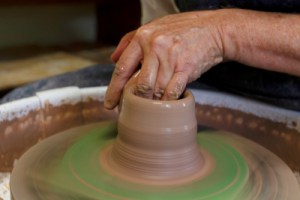
Have thine own way, Lord!
Have thine own way!
Thou art the potter,
I am the clay.
The lessons of the hymn
How would you describe the main theme of her hymn?
Adelaide Potter wrote the hymn in 1907 after being very disappointed that she could not raise the funds to make the journey to Africa to become a missionary. Very despondent, she attended a prayer meeting and overheard an elderly lady praying, “It really doesn’t matter what you do with us, Lord, just have your own way with our lives.” Pollard linked this prayer to the potter described in Jeremiah 18:3-6 and wrote the entire hymn that evening after returning from the prayer meeting.
So, is the theme you selected significantly different from the idea conveyed in Invictus?
I would propose the main theme of this hymn is humility. Why? The entire hymn feels like Pollard’s prayer for God to have His own way in her life. She calls upon Him to mold her and make her after His will . . . not her own. She is humbly waiting on Him to work in her life. She wants Him to “hold over her being absolute sway!” Her words portray someone who has yielded their life (and will) to God. She is saying it’s not about me but it’s Thy will be done . . . just as Jesus taught us to pray!
The biblical case for humility
I would go so far as to say that humility is the beginning of the Christian life! But let’s not rely on my opinion. See what the Bible has to say about the importance of humility. To begin with, the words humility or humble occur 88 times in the NIV Bible (Old and New Testaments). Most of us would accept the idea that pride or proud is the opposite concept. Those two words appear 107 times in the NIV Bible. So, the Bible has a great deal to say to us about this notion.
Obviously, we cannot examine all those occurrences in this meditation. So, I want us to look at a few significant passages.
First, let’s look in the wisdom literature.
You save the humble but bring low those whose eyes are haughty (proud). Psalm 18:27
He guides the humble in what is right and teaches them His way. Psalm 25:9
He has no use for conceited people, but shows favor to those who are humble. Prov 3:34
Whoever has haughty eyes and a proud heart, I will not tolerate. Psalm 101:5b
The Lord detests the proud of heart. Be sure of this:They will not go unpunished. Prov 16:5
Haughty eyes and a proud heart-the unplowed field of the wicked-produce sin. Prov 21:4
Now I would like for us to look at three significant passages regarding the importance of humility. First, we turn to Isaiah 66, the last chapter in that powerful book. Here we find these words from God.
This is what the Lord says:
“Heaven is my throne,
and the earth is my footstool.
Where is the house you will build for me?
Where will my resting place be?
2 Has not my hand made all these things,
and so they came into being?”
declares the Lord.“These are the ones I look on with favor:
Isaiah 66: 1-3
those who are humble and contrite in spirit,
and who tremble at my word.”
In the first two verses God is saying that He dwells in the heavens and does not need for us to build Him a house. He made everything that we could possibly use to provide a place for Him. So, it is foolish and arrogant for us to think that we can build something for Him. Those who think an earthly house built by us would be a fitting resting place for God are haughty and prideful.
In verse 3 we find a great revelation from God as described by Edward J. Young in his commentary on Isaiah.
“There is, however, one unto whom the Lord will look with affection and favor, namely the afflicted (not through outward afflictions but through a broken heart), the contrite in spirit (cf. 57:15; 61:1), the one who trembles at God’s word.”
Our second passage for analysis of the importance of humility is found in Micah. In chapter 6 we find the following word from God through the prophet, Micah (verses 6 – 8).
With what shall I come before the Lord
Micah 6: 6-8
and bow down before the exalted God?
Shall I come before him with burnt offerings,
with calves a year old?
Will the Lord be pleased with thousands of rams,
with ten thousand rivers of olive oil?
Shall I offer my firstborn for my transgression,
the fruit of my body for the sin of my soul?
He has shown you, O mortal, what is good.
And what does the Lord require of you?
To act justly and to love mercy
and to walk humbly with your God.
In this passage the prophet poses the question of how we should appease God. He suggests a series of worldly things which progress in importance from a year old calf to our first born. Then, he answers the question based on what God has shown us will satisfy Him. We are to act justly, love mercy and walk humbly with Him. These actions come from a pure heart and one that has willfully submitted to God in reverence and awe.
Our third passage comes from the New Testament, the second chapter of the book of Philippians. It would be prohibitive to present the entire chapter here. But, I encourage you to read and study this chapter. I especially encourage you to identify the four people Paul uses as examples in the chapter and describe what is uniquely significant about each one.
There are several verses which are critical to our discussion of humility. In verses 3 – 4 we read the following.
“Do nothing out of selfish ambition or vain conceit. Rather, in humility value others above yourselves,not looking to your own interests but each of you to the interests of the others.”
Philippians 2: 3-4
So, from this passage we see that humility includes valuing others above ourselves. Such an attitude results in our putting the interests of others as a priority along with or even ahead of our own. Beginning in verse 5, we are admonished to have the same attitude as Christ.
Then in verses 6 through 8 Paul describes that attitude. Basically it amounts to the following. Christ was with God and was God. But, He gave all of that up to become a man and suffer and die for our sins. Paul uses the phrase “humbled himself and became obedient to death – even death on a cross.” This level of humility is not humanly attainable. But, it is the example to which we should aim. Paul offers himself, Timothy, and Epaphroditus as additional examples of individuals who exhibit the attitude described in verses 3 and 4.
In his Sermon on the Mount, Jesus taught eight beatitudes. The first one is, “Blessed are the poor in spirit, for theirs is the kingdom of heaven.” Being in the kingdom of heaven begins with acknowledging our sin by humbling ourselves before God. Jesus told the parable of the Pharisee and the tax collector in Luke 19. The Pharisee stood up to pray in public saying that he was not like the others . . . he kept God’s laws . . . he was righteous! When the tax collector began to pray, he stood at a distance and would not even look up to heaven. But, he beat himself and cried, “God, have mercy on me, a sinner.” Jesus concluded the parable with this dramatic result: the tax collector was the one who was justified by God . . . not the Pharisee. The Pharisee compared himself to other men and claimed to be better . . . without sin. The tax collector approached God with a broken and contrite spirit . . . he humbled himself before God. This is the beginning of salvation, sanctification and glorification! Humility is the key!
My prayer is that each of us (I especially) will “have the mind of Christ” so that we approach God as the tax collector did . . . not like the Pharisee.
Amen.

